SDP 1: Reactive Speaker
The first somatic design project is our approach to enhancing the musical experiences of individuals with visual and hearing impairments. The project aims to engage the four senses, touch, sight, motion, and hearing, to provide a more immersive experience for users. The prototype's focus is on designing a wireless speaker that allows hearing impaired users to feel the vibration patterns of any song rather than their limited sense of sound. The design will feature lights that flash based on the intensity of the song, providing a better experience for users. The wireless speaker also provides users with visual impairments the chance to control the volume through kinaesthetic interactions with an ultrasonic sensor.

Design
Process
The images and descriptions below show the design process of the SDP 1 Speaker.
Ideation
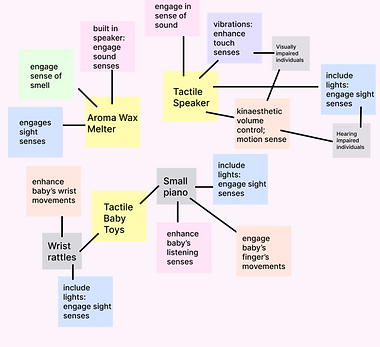
To start off with our design process, we decided to create a mind map which we could collaborate by sharing our ideas. We were aiming to create a product which engages a somatic experience for users.
Sketch

After the ideation process, we created a rough initial sketch on what our product is going to look like. It includes the speaker, vibrations, lights, motion control.
Feature Highlight 1

We also created a sketch where we discussed the features of the prototype while highlighting the process of it.
Feature Highlight 2
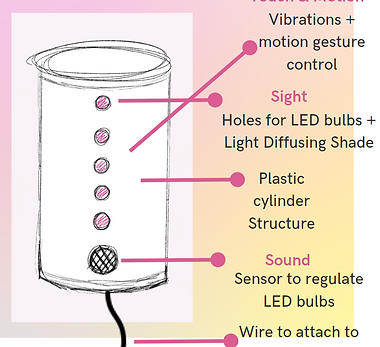
This is the same as the first feature highlight, only the second part.
Gathering Materials

After all the thinking and design processes, we decide to start gathering materials. We got clay, scissors, a cup, wires, a breadboard, Arduino uno, LED lights and a microphone sensor.
Assembly 1

In this process, we started assembling the materials together. The image above shows the Arduino with the breadboard as we were testing the functionality of the early prototype.
Assembly 2

We experienced a few technical difficulties during this stage of the assembly as the clay started cracking and falling apart. To solve this, we decided to use a plastic cup from a bubble tea which housed the prototype.
Assembly 3

The image above shows the final assembly of the prototype circuit before it's placed in the plastic cup.
Final Prototype
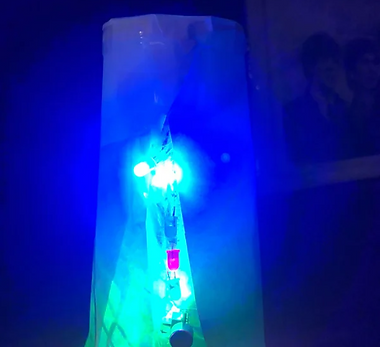
After all the ideation, development and assembly, we finally created the prototype which is seen in the image above with working reactive LED lights.
Evaluation
To evaluate, the somatic design project proposed is a creative and innovative idea which aims to enhance the musical experiences of individuals with visual and hearing impairments. The focus on the four senses, touch, sight, motion, and hearing is well thought out and will provide a more immersive experience for users. The use of recycled materials such as plastic cups, clay, and paper mache is an excellent example of socially responsible design, as it is environmentally friendly and cost-effective. The incorporation of an ultrasonic sensor is also a great addition, as it allows users with visual impairments to control the volume through kinaesthetic interactions. The use of Arduino and LED lights to create a light display that flashes based on the intensity of the song is a creative approach that will provide a more enlightening experience for users. The consideration of people's sensitivity to light and the implementation of a light-diffusing shade is a step towards making the design more user-friendly. Overall, the approach and methods used in this project are great and the prototype has the potential to make a significant impact on the lives of individuals with visual and hearing impairments.